

What if the source of your chronic tension isn't where you feel the pain, but rather a hidden restriction in your connective tissue? It's a common struggle for the 20% of adults who, according to 2023 CDC reports, live with persistent discomfort and feel that standard physical therapy is too aggressive. You've likely experienced the frustration of temporary fixes like daily pain medication that never seems to reach the underlying issue. Our clinical experience shows that myofascial release therapy offers a different path by focusing on the body's fascial system to achieve lasting results.
We're here to show you how this specialized service identifies and treats the root-cause of your stiffness to restore your mobility and comfort. You deserve a personalized approach that respects your body's limits while pushing toward genuine healing. This guide provides a detailed look at how myofascial release therapy works, what to expect during a session, and how it empowers you to return to an active Oregon lifestyle. We'll examine the specific features of this service that make it a cornerstone of holistic wellness for those seeking structural relief.
Key Takeaways
- Learn how targeting the three-dimensional fascial web addresses the underlying structural restrictions that cause persistent discomfort.
- Understand why sustained pressure and time-dependent sessions are essential for effectively elongating restricted connective tissue.
- Discover the critical differences between myofascial release therapy and traditional massage or physical therapy to ensure you receive root-cause care.
- Identify the specific credentials and whole-body philosophy to look for when selecting a qualified provider in the Portland area.
- See how a holistic care plan integrates fascial health with other naturopathic services to support your long-term wellness journey.
The Role of Myofascial Release Therapy in Managing Chronic Pain in Oregon
Myofascial release therapy is a specialized, hands-on service that addresses deep-seated restrictions within your connective tissue. This therapy focuses on the fascial system, a sophisticated 3D web that surrounds every muscle, bone, and organ in your body. For Oregon residents, the physical demands of our unique environment often dictate the health of this system. Whether you're hiking the steep elevations of the Cascades or spending 40 hours a week at a tech desk in Portland, your fascia adapts to these repetitive patterns. Our clinic provides a service that prioritizes a root-cause investigation. We don't just mask symptoms; we look for the structural source of your pain to ensure long-term relief.
To better understand how these techniques work on a physical level, watch this helpful video:
What is Fascia and Why Does it Tighten?
Fascia acts as the body’s internal suspension system, maintaining structural integrity while allowing for fluid movement between muscle groups. In its healthy state, this tissue is relaxed and pliable. Restrictions occur when the fascia becomes dehydrated or bound due to physical trauma, repetitive stress, or an inflammatory diet. These restrictions can exert crushing pressure on sensitive structures. A myofascial restriction is a source of invisible pain that frequently fails to appear on standard imaging like X-rays or CAT scans. Understanding what is myofascial release helps patients recognize how sustained, gentle pressure can rehydrate this tissue and restore its natural elasticity.
Conditions Treated by Myofascial Release
The effectiveness of myofascial release therapy extends to a wide range of debilitating conditions. Our service provides targeted relief for structural issues that traditional medicine often struggles to resolve. This approach is particularly beneficial for:
- Chronic back and neck pain: Releasing the tension that pulls the spine out of alignment.
- Migraines and tension headaches: Addressing restrictions in the cervical and cranial fascia.
- Fibromyalgia: Reducing the systemic sensitivity and "tender points" throughout the body.
- Pelvic floor dysfunction: Restoring balance to the internal pelvic structures and nerves.
- Carpal tunnel syndrome: Relieving the pressure on the median nerve caused by tight wrist and forearm fascia.
- Scar tissue: Softening the dense adhesions that form after surgeries or vehicle accidents.
By focusing on these deep adhesions, the service helps you regain a full range of motion. This approach empowers you to move beyond temporary fixes and begin a journey toward lasting physical freedom. Our clinical team investigates each restriction with genuine curiosity, ensuring that your specific lifestyle factors are considered during every session.
How Myofascial Release Therapy Targets the Root Cause of Dysfunction
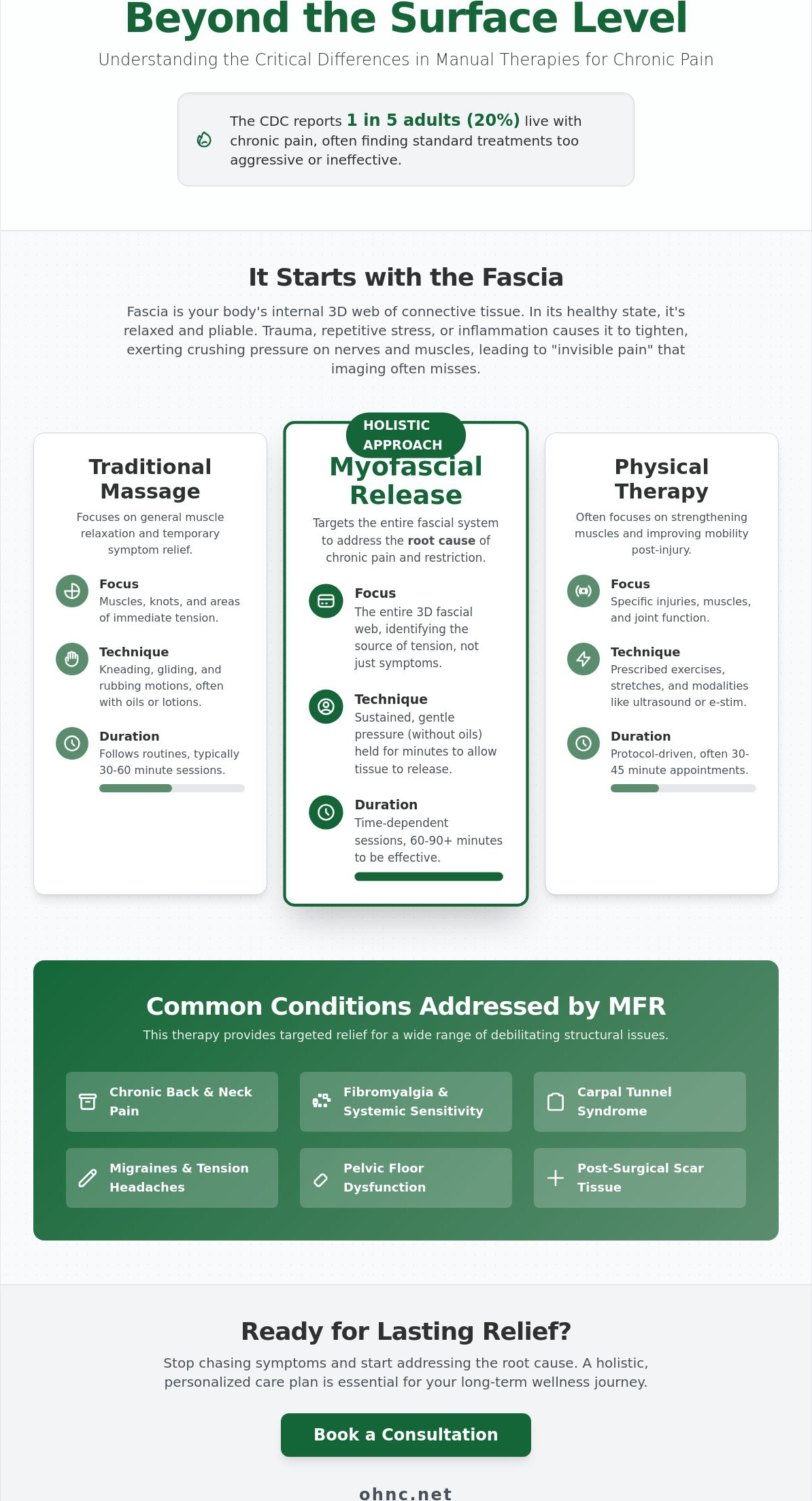
Traditional treatments often focus exclusively on the site of pain, yet myofascial release therapy addresses the underlying structural restrictions that cause that pain to persist. This service relies on a sustained pressure technique designed to elongate restricted fascial tissue. Unlike a standard massage that lasts 30 or 45 minutes, these sessions are intentionally time-dependent, typically spanning 60 to 90 minutes. This duration is necessary because fascia is a stubborn, high-density tissue that requires several minutes of constant contact before it begins to yield.
Therapists don't follow a pre-set protocol or a "routine" during your visit. Instead, they use their hands to feel for specific tissue barriers, which are areas where the fascia has become thick, dehydrated, or adhered. The process is deeply collaborative. You aren't just a passive recipient; your feedback regarding "therapeutic pain" or a sense of release helps guide the provider to the next restriction. This partnership ensures that the treatment moves at the pace your body allows, preventing the defensive guarding that often occurs with aggressive, high-velocity adjustments.
The Science of Sustained Pressure
The effectiveness of this service is rooted in the piezoelectric effect. When a therapist applies steady pressure, it creates a low-grade electrical flow within the tissue that signals the body to begin the healing process. This pressure facilitates a transition in the fascia's ground substance from a thick, viscous "gel" state to a more fluid "sol" state. Recent research on Myofascial Release Therapy supports its ability to improve mobility and reduce chronic pain by changing these physical properties of the tissue. Quick, aggressive movements found in traditional massage don't work for fascia because the tissue reacts to sudden force by tightening further to protect the body.
Assessment vs. Treatment
Every session begins with a visual postural assessment to identify the "source" of your dysfunction rather than just the symptoms. Fascia is a continuous web that spans from head to toe. This explains why a therapist might spend a significant portion of the session working on your hip or pelvis to resolve chronic neck pain. If a restriction in the lower body is pulling the entire fascial web downward, the neck will remain tight until that anchor is released. A single session provides immense diagnostic value, helping you begin your journey toward understanding the specific mechanical imbalances in your body. This investigative approach transforms the appointment from a temporary fix into a long-term structural solution.
Comparing Myofascial Release Therapy to Traditional Massage and Physical Therapy
Choosing the right path for pain relief requires understanding how different modalities interact with your body. Traditional Swedish or deep tissue massage focuses primarily on the muscular layer. These techniques often use oils to glide over the skin, providing temporary relaxation that might last 24 to 48 hours. While pleasant, they rarely address the underlying structural restrictions. Myofascial release therapy is different. It targets the fascia, the tough, continuous web of connective tissue that stabilizes every muscle and organ. Instead of sliding over the surface, the practitioner applies sustained, low-load pressure into the tissue for three to five minutes at a time. This slow approach allows the "gel" of the fascia to melt, creating permanent structural changes rather than temporary relief.
Many patients seek out our clinic after 10 or 15 sessions of traditional physical therapy have failed to resolve their symptoms. Standard physical therapy often prioritizes strengthening exercises and stretching protocols. While these are valuable, they can't effectively strengthen a muscle that's trapped in a restricted fascial "straitjacket." Myofascial release therapy focuses on the manual release of these binds first. The sensation is unique; it's often described as "gentle but deep." You won't experience the aggressive friction of deep tissue work or the high-velocity "cracking" of a chiropractic adjustment. It's a slow, steady melt that reaches deep into the body's structural layers.
MFR vs. Trigger Point Therapy
Trigger point therapy focuses on isolated "knots" or hyper-irritable spots within a single muscle. While this provides immediate localized relief, the results often fade because the surrounding fascial plane remains tight. MFR addresses systemic fascial planes that span from your head to your toes. Think of it this way: MFR treats the "container" of the body, while trigger point therapy only addresses the "content" inside. By releasing the entire fascial web, we prevent the tension from pulling the muscle back into a knot, leading to results that can last for months or years rather than days.
Why Integration Matters
We believe that physical relief is most effective when paired with internal support. Combining MFR with naturopathic primary care allows us to address the biochemical factors that influence your recovery. Fascia is roughly 70% water; if your body is chronically dehydrated or lacks essential electrolytes, your tissues won't "glide" properly regardless of how much manual therapy you receive. By integrating nutritional support and lifestyle medicine, we ensure your tissues are hydrated and resilient. This synergy allows the physical releases achieved during your session to integrate fully into your daily life. Begin your journey toward a body that moves without restriction by addressing both the structure and the source.
Selecting the Right Myofascial Release Provider in the Portland Metro Area
Finding a provider in the Portland area requires more than a simple search for massage. To address the root-cause of chronic pain, you need a specialist who understands that restricted fascia can exert up to 2,000 pounds of pressure per square inch on sensitive internal structures. Effective myofascial release therapy depends on a practitioner's ability to sustain pressure for five minutes or longer to achieve a permanent physical change in the tissue. This isn't a temporary fix; it's a structural realignment.
Look for Licensed Massage Therapists (LMT), Physical Therapists (PT), or Naturopathic Doctors (ND) who have moved beyond general education. Since the Oregon Board of Massage Therapists requires 625 hours of basic training for licensure, you should seek providers with additional, specialized certifications in the John Barnes MFR approach. This specific training ensures the provider treats the entire body as an interconnected web rather than a collection of isolated symptoms. A whole-body philosophy is essential because the source of your pain is rarely where you actually feel it.
Evaluation Criteria for MFR Services
A high-quality clinical environment prioritizes your recovery through dedicated, 1-on-1 sessions. Your provider shouldn't multitask or leave you alone in the room with a heating pad while they see other patients. Verify that your therapist has at least 2 years of experience treating your specific condition, whether it's 4th-degree neuropathy—for which the Neuropathy Relief Project offers specialized nerve pain management consultations—or post-surgical hip pain. Ask these specific questions before booking your first appointment:
- How many hours of specialized myofascial release therapy training have you completed through the John Barnes curriculum?
- Do you use a whole-body approach to find the source of my pain, or do you only treat the symptomatic area?
- Will I have your undivided attention for the full 60 or 90 minutes of the session?
What to Expect in Your First Session
Your initial visit focuses on discovery. It starts with a comprehensive intake process and a detailed postural analysis to identify where your fascia is pulling your skeleton out of alignment. This is a clinical partnership. You'll notice a "no lotion" rule during the session. Oils and creams cause the therapist to slide over the skin, making it impossible to grip and stretch the underlying fascial system effectively.
Healing isn't always linear. You might experience a "healing crisis" after your first few sessions. This natural part of recovery often involves 24 to 48 hours of mild soreness or even emotional release as your body adjusts to its new structural alignment. This response confirms that the therapy is reaching the deep, restricted layers of your tissue. It's a sign that your body is finally letting go of long-held patterns of tension.
Integrating Myofascial Release into a Holistic Naturopathic Care Plan
At Optimum Health Naturopathic Clinic (OHNC), we view the musculoskeletal system as an interconnected network rather than a collection of isolated parts. We use myofascial release therapy as a cornerstone of our holistic physical therapy services. This manual technique doesn't exist in a vacuum; we pair it with internal diagnostics to ensure your connective tissue has the biological support it needs to heal. Chronic fascial tension often correlates with systemic inflammation identified through our food sensitivity testing services. When we identify and remove inflammatory triggers from your daily diet, the fascia becomes significantly more responsive to manual release, which accelerates your recovery timeline.
Fascial elasticity depends on consistent cellular hydration and mineral balance. We offer specialized IV therapy services to deliver essential minerals and electrolytes directly into your bloodstream. This delivery method bypasses the digestive tract, ensuring a 100% absorption rate for nutrients like magnesium and potassium that are vital for muscle relaxation. Dehydrated fascia becomes brittle and prone to painful adhesions. This vulnerability is especially evident when the skin and underlying tissues are damaged by environmental stressors; for example, resources from Local Foot Doc provide guidance on managing tissue health in the feet after such exposures. Our integrative approach ensures your tissue is hydrated from the inside out, making the physical manipulation of the fascia more effective and less uncomfortable during your sessions.
The OHNC Difference: Root-Cause Investigation
Our "Scientific Caretaker" approach combines hands-on myofascial release therapy with advanced diagnostics like Nutrigenomix. This genetic testing analyzes 70+ specific markers to reveal how your body processes collagen and manages oxidative stress. We apply these insights to our specialized pediatric naturopathic care and women’s health services. In pediatric cases, we use gentle myofascial techniques to support developmental alignment as children grow. For women, MFR addresses pelvic floor tension and surgical scarring. It integrates seamlessly with our hormone balancing protocols, as estrogen levels directly impact the structural integrity and moisture content of your fascial tissues.
Next Steps for Your Recovery
If you're ready to address the source of your discomfort, you can schedule a specialized MFR assessment at our Hillsboro clinic. Our providers spend 60 to 90 minutes during your initial evaluation to map out your specific fascial restrictions and health goals. Our administrative staff provides a transparent process for insurance verification to help you understand your coverage for therapeutic services before you begin. We work with several major Oregon insurance providers to keep your care accessible and streamlined.
Reclaim Your Mobility Through Root-Cause Healing
Finding lasting relief from chronic pain requires moving beyond surface-level symptoms. You've discovered how myofascial release therapy differs from traditional massage by targeting the underlying connective tissue restrictions that cause physical dysfunction. At Optimum Health Naturopathic Clinic, we combine this specialized hands-on technique with advanced diagnostic tools to create a personalized recovery plan. Dr. Jason Black, ND, brings over 20 years of clinical experience to the Portland Metro community, ensuring your care is both scientifically grounded and compassionate. Our integrative model doesn't just manage discomfort; it investigates the biological factors behind your pain through a holistic lens. By pairing manual therapy with lifestyle medicine, we help you transition from temporary fixes to sustainable wellness. You don't have to navigate this process alone. Our team is ready to provide the investigative care you need to feel like yourself again. Begin your journey to root-cause healing by scheduling a consultation at our Hillsboro clinic. We look forward to supporting your path toward a more vibrant and pain-free life.
Frequently Asked Questions
Is myofascial release therapy painful?
Myofascial release therapy isn't typically painful, though it involves sustained, gentle pressure that may feel intense at times. Unlike aggressive deep tissue work, this service focuses on a slow melt into the fascia. You might experience a 3 out of 10 sensation on a discomfort scale during the 90 second to 5 minute holds. Our providers prioritize your comfort to ensure the nervous system remains relaxed for effective root-cause healing.
How many sessions of myofascial release will I need?
Most patients see initial results within 3 to 6 sessions scheduled over a 4 week period. Chronic conditions involving long-standing fascial restrictions often require 10 to 12 sessions to achieve lasting structural change. Your provider develops a personalized plan after the first 60 minute assessment. This targeted approach ensures we address the root-cause of your physical limitations rather than just providing temporary relief for your symptoms.
What should I wear to a myofascial release therapy session?
You should wear loose-fitting clothing like gym shorts and a tank top or sports bra for your session. Myofascial release therapy requires the therapist to observe your postural alignment and skin quality without the barrier of thick fabrics. Avoid wearing jeans, leggings, or heavy sweaters. These items restrict the provider's ability to apply the precise, skin-to-skin pressure necessary for effective fascial manipulation and movement assessments.
Can myofascial release help with chronic headaches or migraines?
Yes, myofascial release therapy effectively reduces the frequency of chronic headaches and migraines by releasing restrictions in the cervical spine and cranial fascia. Research indicates that 75% of tension-type headaches stem from myofascial trigger points in the upper trapezius and neck muscles. By softening these tissues, we restore proper blood flow and nerve conduction. This service helps you begin your journey toward a life free from recurring head pain.
Is myofascial release therapy covered by insurance in Oregon?
Coverage for myofascial release therapy in Oregon depends on your specific insurance plan and whether the service is billed as physical therapy or manual therapy. Many regional providers like Providence or BlueCross BlueShield of Oregon include these services when they're medically necessary. We recommend verifying your benefits for CPT code 97140 before your first visit. Our clinic provides the documentation needed to support your claim for root-cause treatment.
How is myofascial release different from a deep tissue massage?
Myofascial release therapy differs from deep tissue massage by using long, sustained holds instead of repetitive gliding or kneading strokes. While massage focuses on temporary muscle relaxation, this service targets the connective tissue system. Therapists apply gentle pressure for 120 seconds or more to allow the fascia to physically reorganize. This method avoids the rebound pain often associated with high-velocity massage techniques while providing deeper, structural results.
What should I do after a myofascial release session to maximize results?
You should drink at least 16 ounces of water immediately following your session to support tissue rehydration. Gentle movement, such as a 15 minute walk, helps your body integrate the structural changes and maintain new range of motion. Avoid high-impact exercise or heavy lifting for 24 hours. These steps ensure your nervous system settles and the fascial system remains fluid as you continue your healing journey with us.
Can I perform self-myofascial release at home?
You can perform self-myofascial release at home using tools like foam rollers, therapy balls, or specialized sticks. We provide specific 5 minute home programs that complement your in-office sessions and maintain tissue mobility between appointments. While professional therapy addresses complex structural patterns, daily self-care helps manage 80% of minor daily tension. These home-based services empower you to take an active role in your long-term wellness and pain management.
Disclaimer
for educational purposes only