
What if the reason your leg keeps failing you on the trails isn't just bad luck, but a failure to address your body's hidden biomechanical imbalances? You've likely spent weeks resting, only to feel that sharp, familiar pull the moment you step back onto the pitch. Understanding exactly what a hamstring strain means for your specific anatomy is essential, as research published in the British Journal of Sports Medicine shows that 34% of these injuries recur within a year when the root cause is ignored.
It's exhausting to receive vague advice to "just wait" while your Oregon lifestyle sits on the sidelines. At Optimum Health Naturopathic Clinic, we believe your recovery deserves more than a temporary fix. We'll help you identify your specific injury grade and introduce you to our holistic physical therapy services in Hillsboro. By utilizing advanced recovery technologies and personalized lifestyle medicine, we'll create a plan that doesn't just heal the tear but prevents it from coming back. This guide previews our clinical approach to restoring your mobility and beginning your journey back to peak performance.
Key Takeaways
- Gain a clear clinical understanding of what a hamstring strain entails by identifying which of the three posterior thigh muscles are impacted.
- Learn how to accurately grade your injury to establish a realistic recovery timeline and ensure your return to sport is safe and sustainable.
- Investigate the root cause of recurring pain by discovering how pelvic alignment and Lower Cross Syndrome contribute to chronic muscle tension.
- Explore advanced recovery services like Class 4 Laser Therapy, designed to stimulate cellular ATP and accelerate tissue repair beyond traditional methods.
- Begin your journey to peak performance at our Hillsboro clinic, where we combine naturopathic primary care with specialized musculoskeletal expertise.
Understanding What a Hamstring Strain Is: Anatomy and Impact
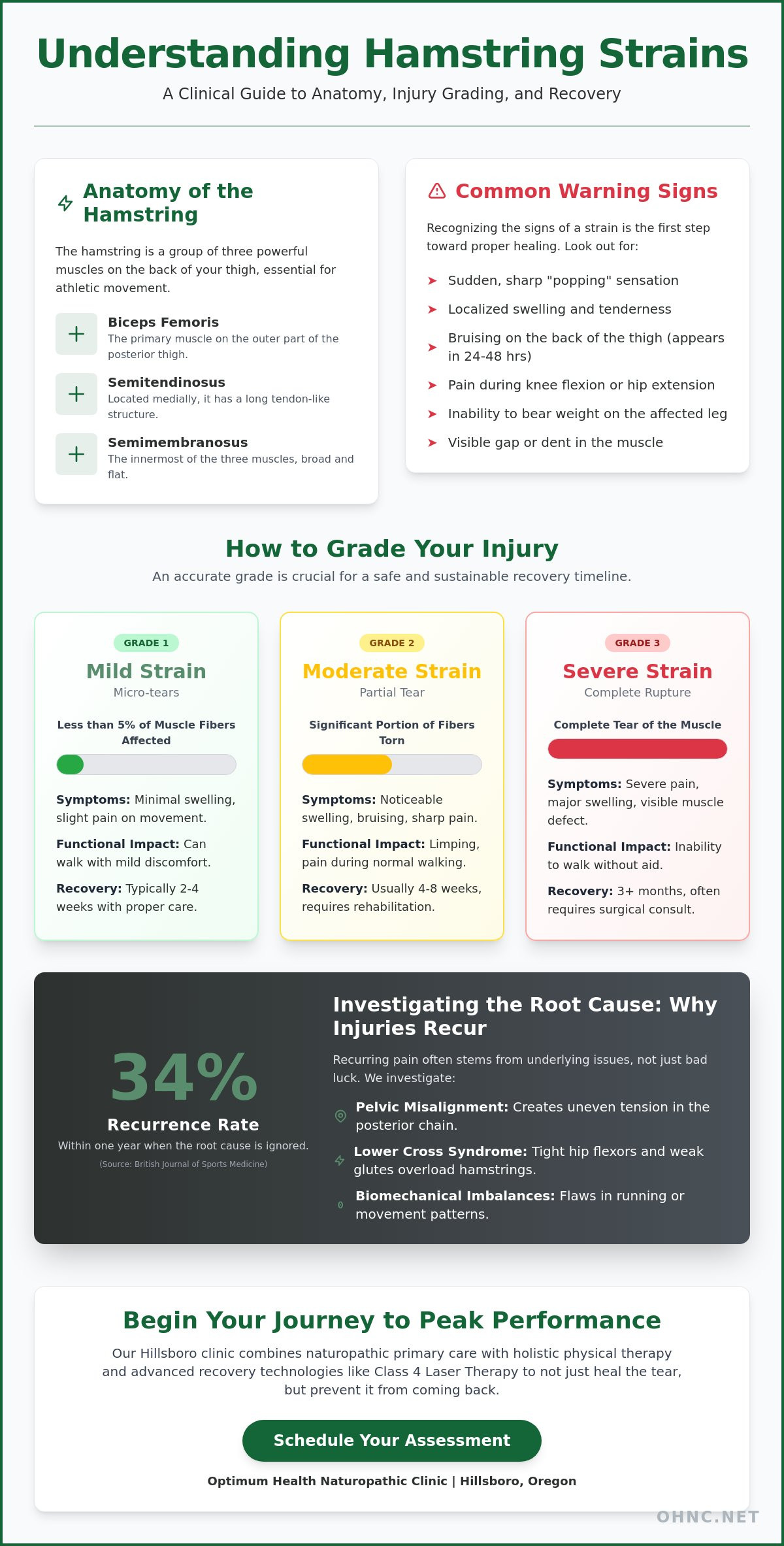
A hamstring strain occurs when one or more of the three muscles running down the back of your thigh experience a tear. Understanding what a hamstring strain actually entails involves looking at the specific muscle group: the biceps femoris, semitendinosus, and semimembranosus. These tissues work together to manage the heavy loads of athletic movement. The Anatomy of the hamstring reveals a complex network designed for power, but it remains vulnerable to sudden eccentric loads. In Oregon, our diverse landscape presents unique challenges for these muscles. Runners tackling the 5,200 acres of Forest Park face steep elevation changes that stress the posterior chain; meanwhile, athletes on Hillsboro’s high-impact sports fields often encounter injuries during rapid acceleration.
To better understand this concept, watch this helpful video:
It's vital to distinguish between a minor "pull" and a clinical muscle strain. A pull is often just microscopic damage or overstretching that resolves with a few days of rest. A clinical strain involves a measurable tear of the muscle fibers, classified from Grade 1 to Grade 3 based on severity. At our clinic, we focus on identifying the root-cause of these tears to ensure your recovery plan addresses more than just the immediate pain.
The Role of the Hamstring in Human Movement
These muscles are the engines of the lower body. They facilitate knee flexion and hip extension, which are the primary motions used during a sprint or a climb up a muddy trail. When you are sprinting at a local track or making a sudden stop on a soccer pitch, your hamstrings act as brakes to decelerate the lower leg. This biomechanical stress is where most injuries happen. The hamstring group functions as a singular, cohesive unit to provide essential posterior leg stability during both static and dynamic movements. Our holistic physical therapy services analyze these movement patterns to prevent future injury.
Common Signs You Have Sustained a Strain
Identifying what a hamstring strain feels like is the first step toward healing. Many athletes report a sudden, sharp "popping" sensation at the moment of injury. This is usually followed by localized swelling and tenderness along the back of the thigh. Within 24 to 48 hours, bruising may appear as blood from the torn fibers settles near the skin. If you cannot bear weight or notice a visible gap in the muscle contour, it's time to seek professional diagnostic testing. Our Hillsboro clinic provides comprehensive evaluations to determine the exact grade of your injury. You can begin your journey toward recovery by scheduling a specialized orthopedic assessment with our team.
How to Grade Your Injury: From Mild Pulls to Severe Tears
Understanding what a hamstring strain actually entails requires a clinical look at muscle fiber integrity. We utilize a three-tier clinical grading system to categorize these injuries based on the extent of tissue damage. An accurate assessment is essential for determining your recovery timeline, especially for Oregonians planning their season around specific races or hiking windows. A generic diagnosis often leads to premature return to activity, which is a leading cause of chronic recurrence.
Our holistic physical therapy assessment differs significantly from a standard urgent care visit. While a typical clinic might provide a basic physical exam and a prescription for rest, we investigate the root-cause of the mechanical failure. This includes analyzing pelvic alignment and nutritional status to ensure the body has the building blocks for repair. Identifying exactly what a hamstring strain grade you are facing allows us to tailor a personalized recovery plan that respects your body's natural healing timeline.
Grade 1: Mild Strains and Micro-tears
Grade 1 injuries involve micro-tears affecting less than 5% of the muscle fibers. Symptoms typically include:
- Minimal swelling or bruising around the back of the thigh.
- Slight pain during peak movement or stretching.
- No significant loss of muscle strength or power.
The typical recovery window for Oregon runners and hikers with Grade 1 injuries is 7 to 21 days. Many athletes make the mistake of ignoring these minor pulls because they can still "run through it." This often results in the formation of disorganized scar tissue. Research indicates that failing to address micro-tears correctly can increase the risk of a secondary, more severe tear by 30% within the following 6 months.
Grade 2 and 3: Moderate to Severe Injuries
Grade 2 injuries are partial tears that result in noticeable weakness and often cause a visible limp. You might feel a "pop" at the moment of injury. Grade 3 injuries are complete ruptures of the muscle or tendon. These severe strains often require advanced diagnostic imaging, such as an MRI, to determine if the tendon has pulled away from the bone. Since hamstring injury symptoms and causes vary in intensity, professional grading is the only way to avoid long-term mobility issues.
Severe strains require a coordinated approach between naturopathic primary care and physical therapy. We focus on managing inflammation through natural protocols while gradually reintroducing load to the tissue. If you feel a loss of function, it's time to begin your journey toward a comprehensive recovery that addresses the whole person, not just the muscle tear. Our team ensures that your return to the trails is supported by evidence-based medicine and functional movement patterns.
Investigating the Root Cause: Why Hamstring Injuries Recur
Treating the localized pain in your thigh is only the first step in a successful recovery. To truly understand what a hamstring strain indicates about your physical health, we must shift focus from the location of the pain to the mechanism of the injury. Recurrent tears often signal that the muscle is overcompensating for imbalances elsewhere. Our clinical team investigates the nervous system's role in muscle guarding, where the brain maintains chronic tightness to protect an unstable joint. This protective tension makes the muscle fibers brittle and prone to snapping under load. We use root-cause diagnostics to determine why your body feels the need to "clutch" these muscles, moving beyond temporary symptom relief into long-term functional stability.
Biomechanics and Pelvic Tilt
Pelvic alignment is a primary driver of hamstring health. When a patient presents with an anterior pelvic tilt, their pelvis rotates forward, which pulls the hamstrings into a constant state of over-stretch. This "Lower Cross Syndrome" forces the muscle to work at its end-range even during rest. Oregon trail runners frequently experience this when weak glutes fail to provide power on steep inclines, leading to hamstring dominance. Our holistic physical therapy evaluations identify these gait abnormalities. We use functional movement screening to assess whether your pelvis is stuck in a position that dooms your muscles to fail. Correcting this alignment through targeted lifestyle medicine and corrective exercise is essential to prevent the cycle of re-injury.
Nutritional and Biochemical Factors
Tissue elasticity and repair capacity depend heavily on your internal biochemistry. We find that many Oregon patients suffer from deficiencies in collagen, Vitamin C, and magnesium, which are the building blocks of resilient muscle fibers. Without these nutrients, the "new" tissue formed during healing is often less flexible than the original muscle. Systemic inflammation can also stall the remodeling phase of recovery. We utilize food sensitivity testing to identify specific dietary triggers that may be hindering your body's ability to clear cellular debris. By addressing these biochemical hurdles, we ensure your recovery journey is supported by optimal internal conditions. What a hamstring strain requires for permanent healing is a blend of mechanical correction and nutritional support.
- Nervous System Regulation: We address chronic guarding patterns that lead to "phantom" tightness.
- Hydration and Electrolytes: Maintaining cellular fluid balance to prevent cramping and micro-tears.
- Personalized Supplementation: Using clinical-grade nutrients to improve the tensile strength of recovering tendons.
Our approach integrates these diverse factors into a single, cohesive plan. We don't just wait for the muscle to stop hurting; we actively build a more resilient athlete through comprehensive lifestyle interventions.
Advanced Recovery Protocols: The Holistic Physical Therapy Approach
Traditional methods like RICE often fall short for athletes who need to return to peak performance quickly. While rest and ice manage initial swelling, they don't address the underlying tissue damage or the biomechanical reasons behind what a hamstring strain does to your movement patterns. Our holistic physical therapy approach shifts the focus from passive waiting to active, technology-driven regeneration that targets the root cause of the injury.
Class 4 Laser Therapy for Tissue Regeneration
We utilize Class 4 Laser Therapy to accelerate the healing of torn muscle fibers through a process called photobiomodulation. This technology delivers high-intensity light energy into deep tissue layers, stimulating cellular mitochondria to produce more ATP. This increase in cellular energy is the fuel required for rapid tissue repair and the reduction of localized inflammation. Unlike lower-level lasers, high-power lasers reaching up to 15 watts provide the depth of penetration necessary for the thick muscles of the posterior chain. High-power laser therapy increases blood flow to poorly vascularized tendons, ensuring that essential nutrients reach the site of the injury. Clinical data suggests that integrating this service can reduce recovery timelines by as much as 30% compared to standard care alone.
Manual Therapies and Myofascial Release
Addressing the root cause of pain often requires breaking down internal physical barriers created by the body's healing process. We use myofascial release therapy to target adhesions and scar tissue that accumulate after an injury. These "sticky" spots prevent the muscle from sliding smoothly against surrounding tissue, which often leads to compensatory movements and reinjury. Restoring this fascial glide is essential for achieving pain-free sprinting and jumping. To support the body’s natural detoxification, we integrate cupping and hydrotherapy into our sessions. These services improve lymphatic drainage, helping clear metabolic waste from the injured site. This comprehensive manual approach ensures that what a hamstring strain leaves behind, such as chronic stiffness or limited range of motion, is effectively resolved.
Strengthening the Posterior Chain
Recovery isn't complete until the muscle is stronger than it was before the injury occurred. We design personalized exercise programs that focus on eccentric loading, which is the process of strengthening the muscle while it's lengthening. This specific type of training "bulletproofs" the posterior chain by improving its ability to absorb force during high-speed movements. We don't just treat the leg; we optimize your entire kinetic chain to prevent future setbacks and enhance athletic power.
Beginning Your Recovery Journey at Our Hillsboro Clinic
Your first visit to our Hillsboro clinic marks the start of a dedicated partnership. We focus on a deep-dive assessment that goes beyond surface-level symptoms. During your initial consultation, we investigate the specific mechanics of your injury to understand exactly what a hamstring strain indicates about your overall movement patterns. We combine naturopathic primary care with advanced musculoskeletal expertise to create a foundation for lasting health. This integrative model allows us to manage your immediate pain while simultaneously optimizing your systemic recovery.
Our team builds personalized treatment plans that reflect your unique Oregon lifestyle. Whether you're training for the Hood to Coast Relay or simply want to enjoy a pain-free walk through Noble Woods Park, your goals dictate our strategy. We utilize a collaborative, patient-centered approach that empowers you with the knowledge to manage your own healing. You'll receive a clear explanation of your diagnosis and a step-by-step plan that includes:
- Targeted holistic physical therapy exercises.
- Nutritional support to decrease systemic inflammation.
- Lifestyle medicine adjustments to improve sleep and tissue repair.
- Root-cause analysis of biomechanical imbalances.
Comprehensive Diagnostic Testing
We believe that effective healing requires precise data. Our clinic utilizes advanced diagnostic panels to ensure your body possesses the necessary raw materials for muscle repair. We look at micronutrient levels and inflammatory markers that traditional checkups often overlook. Our physical assessments analyze the entire kinetic chain, from your lower back to your ankles. By identifying what a hamstring strain reveals about your pelvic stability or glute activation, we create a roadmap for long-term athletic durability. This thorough investigation ensures you aren't just masking pain but actually rebuilding a stronger, more resilient body.
Schedule Your Assessment in Hillsboro
Begin your journey toward peak performance by connecting with our team. Our Hillsboro clinic offers a warm, supportive environment designed to alleviate the stress of injury. We've streamlined our intake process to make scheduling easy and transparent. You can contact us via our secure online portal or call our front desk to verify insurance coverage and book your initial assessment. Our providers are ready to help you move past the limitations of your injury. Don't settle for temporary fixes. Reach out today to address the root-cause of your pain and return to the activities you love with confidence.
Take Control of Your Athletic Recovery Today
You deserve a recovery plan that looks far beyond the surface of your injury. Understanding what a hamstring strain means for your specific athletic goals is the first step toward lasting health. Since 2004, Dr. Jason Black, ND, has led our Hillsboro clinic in providing comprehensive naturopathic primary care that prioritizes your long term mobility. We don't just manage symptoms; we utilize specialized Class 4 Laser therapy to stimulate deep tissue repair at a cellular level. Our providers also incorporate Myofascial Release to restore proper muscle function and eliminate the restrictive scar tissue that causes reinjury. These targeted services address the biomechanical root causes that often lead to recurring pulls. By integrating advanced technology with personalized lifestyle medicine, we help Oregon athletes return to their sport with total confidence. Your path to peak performance starts with an investigative approach to healing that treats your body as a complete system. It's time to move past temporary fixes and embrace a professional strategy built for your unique physiology.
Begin your journey to root-cause recovery; schedule your hamstring assessment at OHNC today.
We're ready to help you achieve your strongest, most resilient recovery yet.
Frequently Asked Questions
How can I tell if I have a hamstring strain or just a cramp?
A hamstring strain involves actual tearing of muscle fibers, while a cramp is a temporary involuntary contraction. If your pain persists for more than 24 hours or you notice bruising, it's likely a strain. A cramp usually resolves within 10 minutes with stretching and hydration. Our clinical assessments identify the exact grade of your injury to start the right recovery journey.
Is it okay to walk with a mild hamstring strain?
You can walk with a mild Grade 1 strain if the pain level remains below a 3 out of 10 on a visual analog scale. Walking helps maintain blood flow, which is vital for tissue repair. However, if you're limping, you're risking secondary injuries to your hips or lower back. We prioritize holistic physical therapy to ensure your gait remains functional while the muscle heals.
How long does a Grade 2 hamstring strain take to heal with holistic therapy?
A Grade 2 strain typically requires 4 to 8 weeks for a full recovery when utilizing integrative medicine. This timeline depends on the 50% partial tear common in Grade 2 injuries. By addressing the root-cause of the injury through nutritional support and personalized therapy, we aim to return you to sport safely. We monitor your progress weekly to adjust your specific treatment plan.
Should I use heat or ice for a pulled hamstring?
Use ice for the first 48 to 72 hours to manage acute inflammation and then switch to heat. Ice constricts blood vessels to reduce swelling, while heat later promotes circulation to the injured fibers. Understanding what a hamstring strain needs at each stage is crucial. Our providers guide you through this transition to ensure you don't stall the natural healing process.
Can a naturopathic doctor help with sports injuries like muscle tears?
Naturopathic doctors provide comprehensive care for muscle tears by combining physical medicine with biochemical support. We use tools like Nutrigenomix to see how your genetics affect tissue repair. This isn't just symptom management; it's a deep dive into your body's ability to heal. Our clinic offers a blend of herbal medicine and evidence-based physical therapy for Oregon athletes.
Why does my hamstring keep getting injured even after I rest it?
Recurrent injuries often happen because the root-cause, such as a pelvic tilt or a 20% strength imbalance between legs, wasn't addressed. Rest alone doesn't rebuild the structural integrity of the muscle. We analyze your movement patterns to identify these deficits. Identifying what a hamstring strain is rooted in prevents the cycle of re-injury and helps you begin your journey toward permanent wellness.
What are the best exercises to prevent hamstring strains in the future?
Eccentric strengthening, specifically Nordic hamstring curls, reduces injury risk by up to 51% according to sports medicine research. We also incorporate hip hinge movements and glute activation drills into your personalized program. These exercises build resilience in the muscle-tendon unit. Our holistic physical therapy focuses on these functional movements to protect your body during high-intensity activities.
Does insurance cover holistic physical therapy in Oregon?
Many Oregon insurance providers cover naturopathic services and physical medicine, though coverage levels vary by specific plan. We provide transparent billing and can verify your benefits before you start your first session. Our clinic works with major carriers to ensure our root-cause care is accessible. Contact our office to discuss your specific insurance details and begin your journey toward recovery.
Disclaimer
for educational purposes only